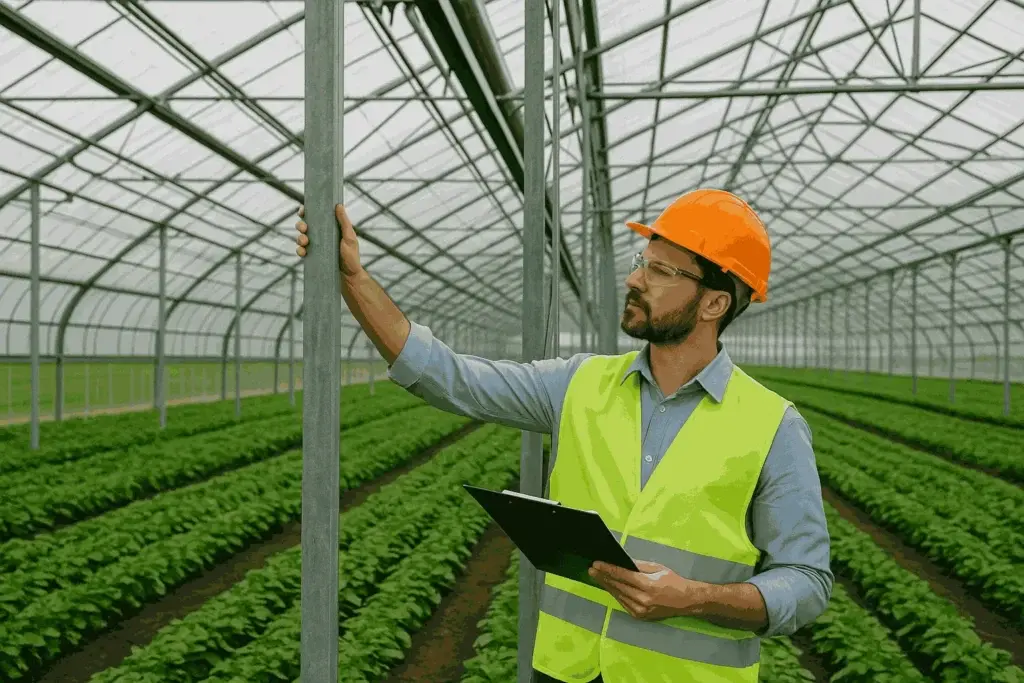
When Agriculture Meets the Defense Industry
Over the past decade, the agricultural world has undergone a quiet but powerful revolution. Agricultural greenhouses have long ceased to be loose sheets of polyethylene; they are now complex engineering systems that require design, fabrication and execution at a high level of precision.
When the goal is to build a greenhouse that operates year-round, in changing conditions, with a minimum of failures, you have to start from the foundation: a smart, strong and precise metal structure. This is exactly where advanced industrial engineering enters the picture, such as that of Damti Brothers, a company that operates to aerospace and defense standards.
Why Is Such a High Level of Precision Required?
The reason is simple: an advanced greenhouse is a living system. It is exposed to humidity, corrosion, strong winds and extreme temperature changes, and sometimes also incorporates moving systems (such as retractable roofs, mobile screens or irrigation rails).
A metal structure that is not well designed will not last. Joints will weaken, an ill-fitting bolt will cause dimensional deviation, and delicate components such as shading or climate-control systems will not operate properly.
In other words: precision in design = stability in the result.
Where Does Industrial Engineering Come Into Play in a Greenhouse?
Meticulous Engineering Design Based on Real Loads
Every greenhouse structure must take into account wind loads, the weight of internal systems, external control systems and even snow loads in certain regions. Applying know-how from the defense industry enables design based on advanced strength calculations.
Precision Manufacturing to Stringent Standards
Damti Brothers operates in accordance with AS9100, the stringent quality standard for the defense and aerospace industries. This means that every component in the structure, from a metal profile to the smallest connector, is manufactured and built to an exact specification, with tight control throughout the entire process.
Full Adaptation to Project Needs
No two greenhouses are alike. Some are intended for seedlings, others for orchards, and some are connected to robotic or automation systems. Designing from the ground up, rather than from a generic template, ensures full compatibility with the agricultural purpose.
Advantages of Bringing Advanced-Industry Metal Engineering into Agricultural Projects
✅ Long service life – the structures are manufactured with engineering precision that allows for minimal failures over the years.
✅ Integration of advanced systems – automation, shading, ventilation and irrigation systems are easier to implement when the preliminary design is precise.
✅ Minimal maintenance – planning ahead for accessibility, concealed electrical conduits or access to connections prevents shutdowns for repairs.
✅ Regulatory compliance – building permits or government support are easier to obtain when the engineering specification is detailed and precise.
When Should You Turn to an Engineering Supplier Rather Than Just a Greenhouse Contractor?
- When the project is large in scale
- When there are special requirements for integrating control systems
- When a unique solution is needed for an extreme climate
- When it is a long-term investment rather than a temporary solution
- When durability, minimal maintenance and reliability are required
In Summary: The Structure Determines the Result
In a world where agriculture is becoming more precise, more advanced and more technology-intensive, metal structures must keep pace with the requirements.
Combining high-level industrial engineering, like that which comes from the defense and aerospace worlds, is a strategic advantage for farmers, developers and contractors seeking quality and precision, not just today, but a decade from now.